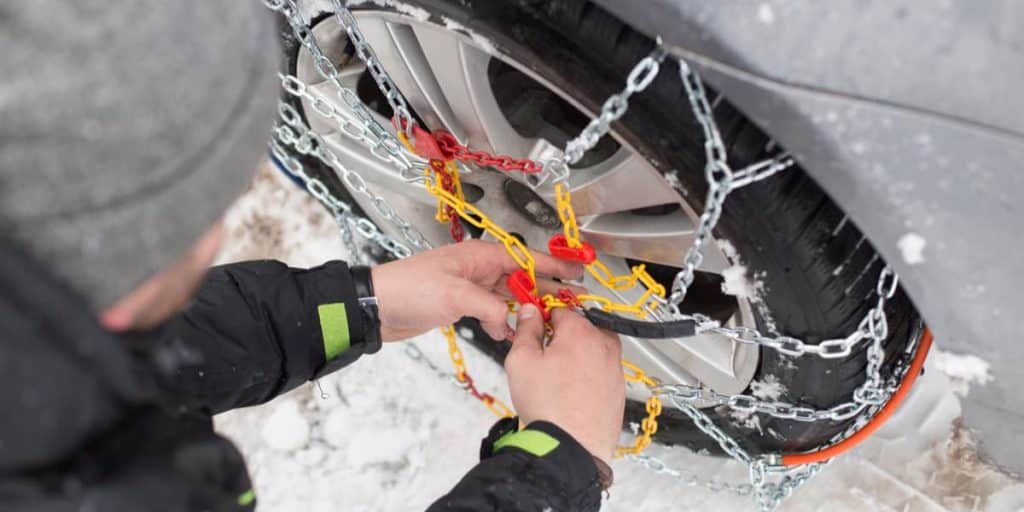
With the arrival of winter, you need to put anti-slip devices back in your car. There are several solutions on the market, including chains and snow socks.
Let’s look at the differences.
Various anti-slip systems
Every time winter returns, thousands of drivers find themselves having to deal with the unpleasant effects of cold weather. Among the effects of the cold, most present serious risks to road safety. Ice, slippery roads, hail, snow, and everything that makes traffic difficult. For this reason, many roads require the installation or possession of snow chains on board.
Until about ten years ago, snow chains were the only anti-slip system sold on the market, as well as the only one legally approved. But technological innovation is moving forward, and new systems are continuously being invented to travel safely on the road. In particular, in the field of anti-slip devices, you can find various systems in stores, such as classic chains, the latest “spider” models, or snow socks. Each of them has different costs as well as various advantages and disadvantages, let’s look at them specifically.
Differences between snow chains and snow socks
If you have ever found yourself in doubt about this choice and have asked someone which system is the best, each will give you a different answer. It is absolutely impossible to say which is the best anti-slip system, as each of the two has different characteristics. Most opinions are therefore always individual and subjective, varying according to the needs and experiences of those who have used the safety systems in question.
Snow chains are undoubtedly the best-known device of the two. The first difference to make between the two is undoubtedly the reception by type. Snow chains must refer to UNI 11313 or ON V5117 to be recognized as valid. The first lists a set of technical specifications to recognize the proper execution of the product, while the second lists the minimum requirements to legally guarantee the road safety of the vehicle.
While it is easy for the type of snow chains to comply with at least one of the two standards, the same cannot be said for snow socks. These have indeed been on the market for a few years, and it was only in 2011 that the Ministry of Infrastructure and Transport, following several appeals from producers, regulated the use of snow socks. They are only recognized under ON V5121, making them equivalent to snow chains. Today, you can safely use snow socks in all areas where there is an obligation to install snow chains or use winter tires.
The second important difference between the two lies in the possibility of installation. In fact, not all vehicles are designed to be adapted by construction. You just need to check the booklet where it clearly states whether the vehicle is “catenable” or “not catenable.” The car may be non-adaptable for several reasons, such as the distance between the wheel and the compartment being too small, so that inserting a chain could damage the mechanical parts. Therefore, all vehicles that are not likely to move for which the requirement for snow chains existed until a few years ago had to install winter tires. Today, however, the problem of non-motorized vehicles can be solved thanks to snow socks. These are made of polyester, a soft material and, above all, less bulky than chains, and make the terrain usable even in case of snowfall.
Another important difference between the two safety systems lies in the ease of assembly, and the spider-type snow chains are also in competition here. Among the three systems, snow chains are the most complex to install, as they must be worn in position and arranged around the entire circumference of the wheel. The new spider systems are particularly easy to assemble because they involve inserting the head into one of the wheel bolts that do not need to be removed during the winter, and then the actual chain is attached to the head and sets itself in place, while chains require moving the car. The snow socks, on the other hand, are applied very easily, almost like a “bag” or a glove. You won’t have to worry too much about centering the bottom as they will settle while moving the vehicle.
Another very important difference lies in the vehicle’s maneuverability. Snow chains, regardless of type, can also be worn on short stretches of bare asphalt. Snow socks, on the other hand, being made of a much less durable material, will wear out desperately even on short stretches of asphalt without snow, thus losing their effectiveness. Snow chains are suitable for almost all situations, but due to their formation, they can cause vibrations in the car while driving. Snow socks, being soft, perform very well on fresh snow but less so on ice, but avoid vibrations. Regarding durability and safety, however, in principle, snow chains are better.
Finally, the last difference between the systems lies in the price. Snow chains are affordably priced, ranging from €20 to €200 per wheel (then more for premium models). Spider chains are the most expensive system of all, ranging from €150 to a maximum of €500 per model. More advanced models even allow you not to have to keep your head mounted throughout the winter. Snow socks, in addition to taking up less space in the trunk, have a very affordable cost between €20 and €70.
Tag: chain or snow tire?