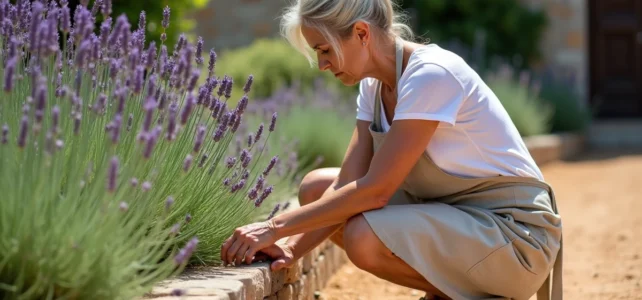
A lavender that droops in the middle of summer, with stems lying on the ground and flowers dragging in the dirt, is often a sign of maintenance issues or poorly adapted growing conditions. This situation can occur both in the ground and in pots, and the causes are rarely isolated. The good news: in most situations, we can rectify the situation if we quickly identify what is wrong.
Lavender that falls after a storm: the trap of saturated soil
The most common and least understood situation is that of a lavender that suddenly droops after a heavy rain episode. The stems, weighed down by water, lie flat, the root ball remains soaked, and within a few days the branches begin to blacken at the base.
Related reading : How to switch to bioethanol for your car?
The problem rarely comes from a single watering. It is the combination of soil that dried out very quickly during a heatwave, followed by a storm that dumps a volume of water that the compacted soil can no longer absorb. Water stagnates on the surface or in the planting hole, and the roots suffocate. In pots, the phenomenon is amplified if the substrate has shrunk and allows water to flow between the root ball and the wall without penetrating.
To remedy this, several solutions for drooping lavender can be considered, starting with checking that the drainage is actually working. In pots, a simple hole at the bottom is not always enough: a layer of gravel or clay balls is needed, along with a substrate that does not compact over time. In the ground, slightly elevating the root ball at planting remains the most effective gesture to avoid stagnant water.
Related reading : Discover how CGI Network is revolutionizing your Internet connection and web services
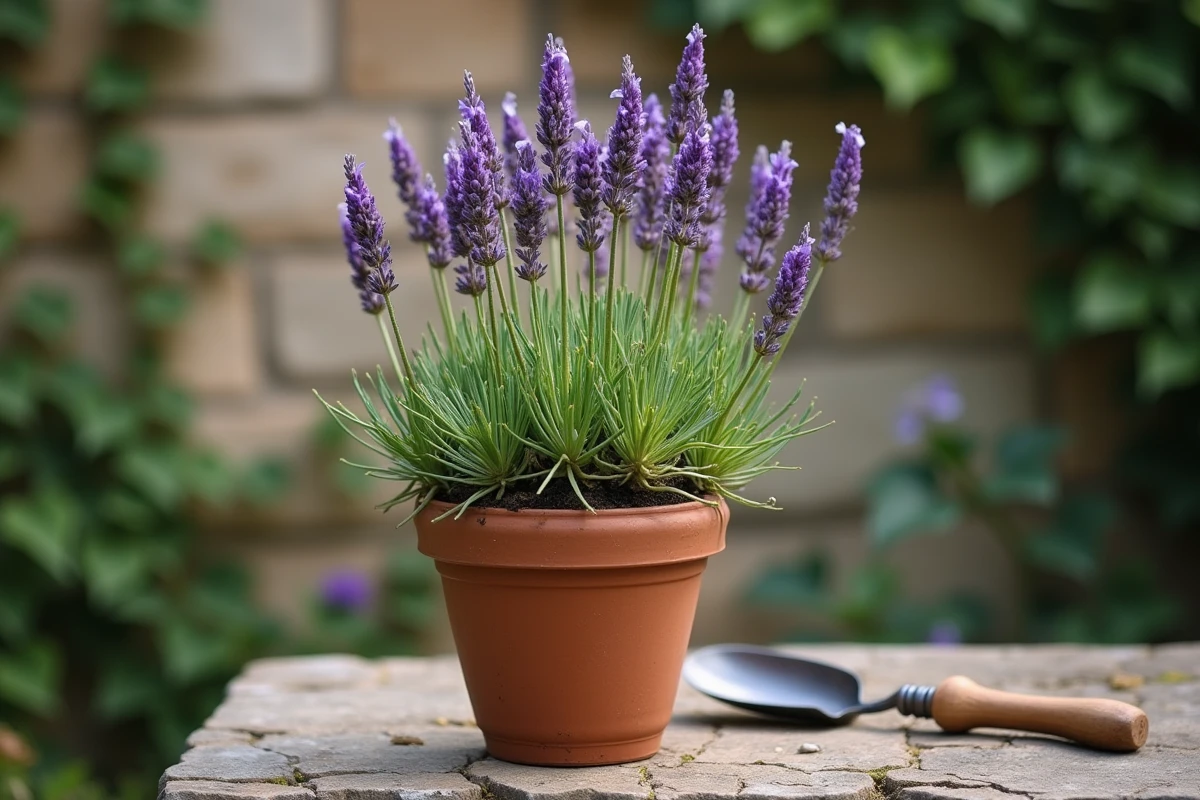
Excess nitrogen fertilizer and soft stems: a common mistake in pots
We often see potted lavenders planted in enriched universal potting soil, sometimes with regular applications of liquid fertilizer. The result is paradoxical: the plant grows quickly, produces long stems, but these remain soft, poorly lignified, and droop at the slightest gust of wind.
Lavender does not need rich soil to remain compact. An overly fertilized substrate, particularly with nitrogen, pushes the plant to produce soft stems rather than solid wood. This is the opposite of what we want.
In calcareous and poor environments, lavender lignifies better, remains stocky, and is more resistant to wind and rain. Specifically, for pot cultivation:
- Mix coarse sand or fine gravel into the potting soil (about one-third of the volume) to impoverish and drain the substrate
- Eliminate all nitrogen fertilizers, especially in spring when growth accelerates
- Add a handful of crushed limestone if the potting soil is acidic, as lavender prefers a slightly alkaline pH
This sensitivity to pH and soil richness is rarely mentioned on commercial potting soil labels. However, an overly acidic substrate gradually weakens lavender and encourages the appearance of fungal diseases that accelerate decline.
Pruning lavender: the action that prevents drooping
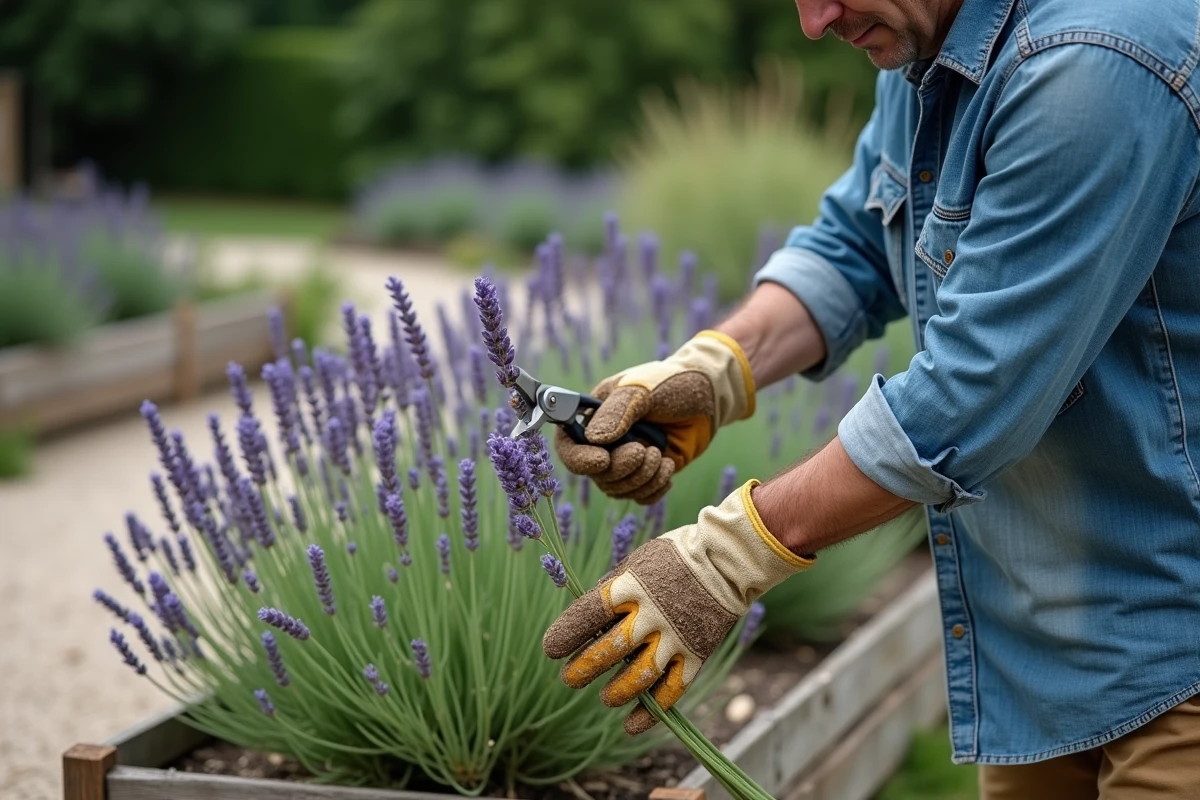
A lavender that is never pruned will eventually open up in its center and fall over on the sides. The wood becomes bare inside, new shoots only emerge on the periphery, and the clump collapses under its own weight. We then reach a stage where the plant appears “collapsed” even in good weather.
Pruning every year just after flowering is the only way to maintain a compact shape over time. We shorten the flower stems and part of the foliage, but without ever cutting into the old bare wood. This is the limit not to be crossed: cutting into the lignified and leafless part often condemns the branch, which does not regenerate.
Reviving an old lavender plant that has already drooped
For an older plant that has opened up, the outcomes vary on this point. Some gardeners manage to tighten the clump by gradually pruning over two years, cutting back a little lower each season while leaving some green leaves on each branch. Others prefer to take cuttings from the still healthy ends and start anew from a young plant.
The practical rule: if you still see green on the majority of the branches, a staggered rejuvenation pruning remains feasible. If the center is entirely woody and dry, it is better to replace the plant.
Drooping potted lavender: check substrate, exposure, and watering
In pots, lavender faces multiple constraints. The volume of soil is limited, the substrate temperature rises quickly in summer, and watering is often either too generous or insufficient.
- Check that the pot is deep enough (at least the height of a hand) to allow the roots to anchor and stabilize the plant
- Place the pot in full sun, for at least six hours a day, as a lack of light causes the stems to stretch upward
- Water only when the soil is dry several centimeters deep, and never leave water in the saucer
- In winter, protect the pot from frost by insulating it with a cover or placing it against a wall, as cold, damp conditions destroy the roots faster than dry frost
A terracotta pot offers better drainage than a plastic pot, and its porosity helps regulate moisture. For regions where winters are mild but rainy, this is a choice that makes a difference.
When lavender no longer stands upright
If the stems remain soft despite good drainage and proper exposure, inspect the base of the branches. A brown or black discoloration at the junction with the soil usually indicates root rot. At this stage, removing the plant, cutting the affected roots, and repotting in fresh, draining substrate remains the only option before losing the plant entirely.
Lavender is a plant of dry, poor soil. Every action that moves it away from these conditions (rich potting soil, frequent watering, pot without drainage, partial shade) brings its stems closer to the ground. Returning to the fundamentals—a poor soil, sunlight, and annual pruning—is often all it takes for it to stand tall.