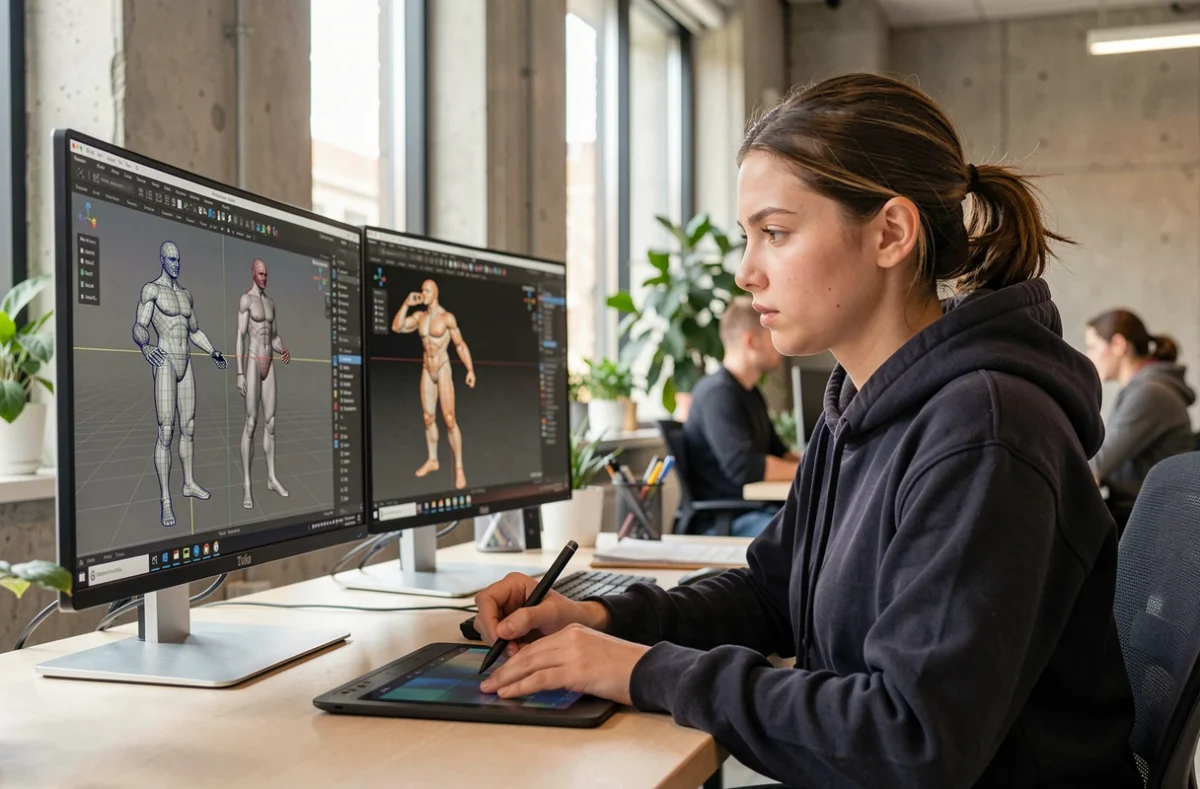
A character running, a dragon spreading its wings, a building collapsing in slow motion: behind each of these sequences, a 3D animator has worked on the movement frame by frame. Once the training is completed, the question of the first job arises. Career opportunities go far beyond animation cinema, and some recent fields are changing the game for junior profiles.
Generative AI and traceability: the skill that redefines the 3D animator profession
Since August 2, 2026, the transparency obligations set out in Article 50 of the European regulation on artificial intelligence apply to the labeling of certain AI-generated or manipulated content. For a 3D animator, this translates into a concrete need: to distinguish between human creation and automated generation at every stage of production.
In practical terms, a studio that uses AI tools to generate textures or pre-calculate movements must be able to trace the origin of each element. The animator who can document their interventions (artistic direction, manual retouches, composition choices) finds themselves in a strong position.
This traceability requirement also affects intellectual property. A fully synthetic production does not automatically benefit from copyright: protection depends on perceptible human creative choices in the result. A portfolio that clearly shows your personal contributions, iterations, and artistic decisions thus has more legal value than an isolated final render. You can explore professional opportunities on Emploi Parlons Net to gauge the extent of the relevant fields.

Careers in 3D animation in cinema and visual effects
Animation cinema and visual effects (VFX) remain the most visible outlet. Studios are looking for animators capable of working on rhythm, acting intentions, and the fluidity of movements on characters or creatures.
But the animator position is just an entry point. From this base, several specializations emerge:
- Environment artist: creating the sets and worlds in which characters evolve. This position requires sensitivity to lighting, materials, and spatial storytelling.
- Lighting and rendering artist: managing light and the final rendering of shots. This is a technical and artistic role that directly influences the emotion of a scene.
- VFX artist: integrating visual effects into live-action footage (explosions, fluid simulations, destructions). This profile often works in post-production.
Career progression generally follows a progressive pattern, from technical execution on isolated shots to coordinating teams spread across multiple international sites.
Video games and motion design: two fields that recruit differently
Video games operate under technical constraints distinct from cinema. Animation must run in real-time, which imposes compromises between visual quality and performance. A 3D animator focused on game design works on movement cycles (walking, running, attacking) that must remain fluid regardless of the player’s hardware.
Why is this distinction useful to know right out of school? Because the transferable skills between cinema and video games are not symmetrical. A profile trained in real-time adapts quite easily to pre-calculated cinema. The reverse often requires a longer adjustment period.
Motion design as a bridge
Motion design represents an often underestimated parallel path. It involves animating graphic elements for advertising, digital interfaces, institutional videos, or social media. Projects are shorter, deadlines are tight, and work is frequently done on a freelance basis.
For a junior, it’s a field where building a varied portfolio in a few months remains possible. Demand is constant: communication agencies, television channels, and brands need animated content continuously.
Architecture, medicine, virtual production: the less visible sectors
The skills of a 3D animator find applications in fields that have nothing to do with entertainment. Architectural visualization employs profiles capable of modeling and animating spaces before their construction. The medical sector uses 3D animation to represent biological mechanisms in an educational or surgical context.
Virtual production, popularized by the use of LED stages in real-time, creates new demand. Filming uses 3D environments projected in the background, which requires animators familiar with both real-time rendering and interactive lighting management.
What these fields have in common
In each of these sectors, technical versatility weighs more than hyperspecialization at the time of hiring. A profile that masters modeling, animation, and the basics of rendering will find it easier to secure a first position than a candidate who is ultra-specialized in a single software.
Recruiters also check the ability to work within a structured production chain, where each participant interacts with other creative poles. Knowing how to deliver clean, documented work that is compatible with the studio’s pipeline is part of the skills assessed from the interview stage.
Preparing your portfolio in light of the new market demands
The portfolio remains the number one recruitment tool in 3D animation. With the rise of generative AI tools, documenting the creative process becomes as useful as showing the final result. A recruiter wants to see your choices: why this pose, why this timing, why this lighting.
Including breakdowns (step-by-step work decomposition) in your portfolio demonstrates both your technical mastery and your ability to trace your contributions. This is an asset for studios subject to the obligations of the European regulation on AI, and it is a strong signal of professional maturity for all others. The market is hiring, but it is hiring profiles that can prove what they know how to do.