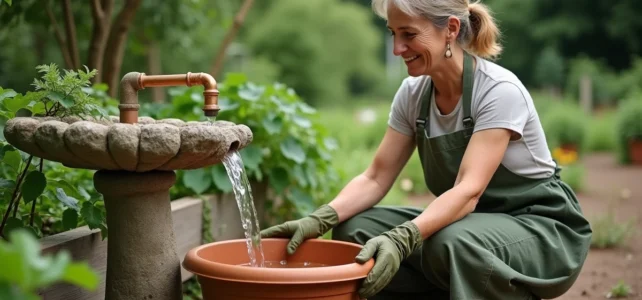
Collecting rainwater without having a roof or a nearby gutter in the garden poses a simple technical constraint: it is necessary to artificially create a catchment surface. Several lightweight devices can address this, but their effectiveness depends on sizing, material choice, and adherence to a few sanitary rules that online tutorials rarely mention.
NF EN 16941-1 Standard and Rainwater Harvesting in the Garden
Most public guides on rainwater collection overlook the regulatory framework. The NF EN 16941-1 standard, with its consolidated version dating from 2023, regulates the design of small-scale rainwater harvesting systems, including for limited use in the garden.
Further reading : Tips and Practical Advice to Simplify Your Daily Life as a Woman
It specifically mandates pre-filtration devices and a strict separation between the rainwater system and the potable water system. Even for a simple barrel placed at the back of the vegetable garden, the principle of non-interconnection applies: a pipe connected to the domestic network must never supply or supplement the rainwater tank.
These requirements may seem disproportionate for watering purposes. However, they aim to prevent cross-contamination, a real risk when installing a supplementary tap on a tank.
Recommended read : Effective tips to reduce your Basic Fit subscription cost in 2024
Field reports vary on the rigor with which these rules are applied in family gardens, but knowing of their existence allows for proper sizing of the installation from the start. As detailed in the article by Le Jardinier Décorateur, several simple setups remain compliant with these principles without requiring heavy work.
Shade Cloth and Tensioned Net: Capturing Rainwater Without a Roof
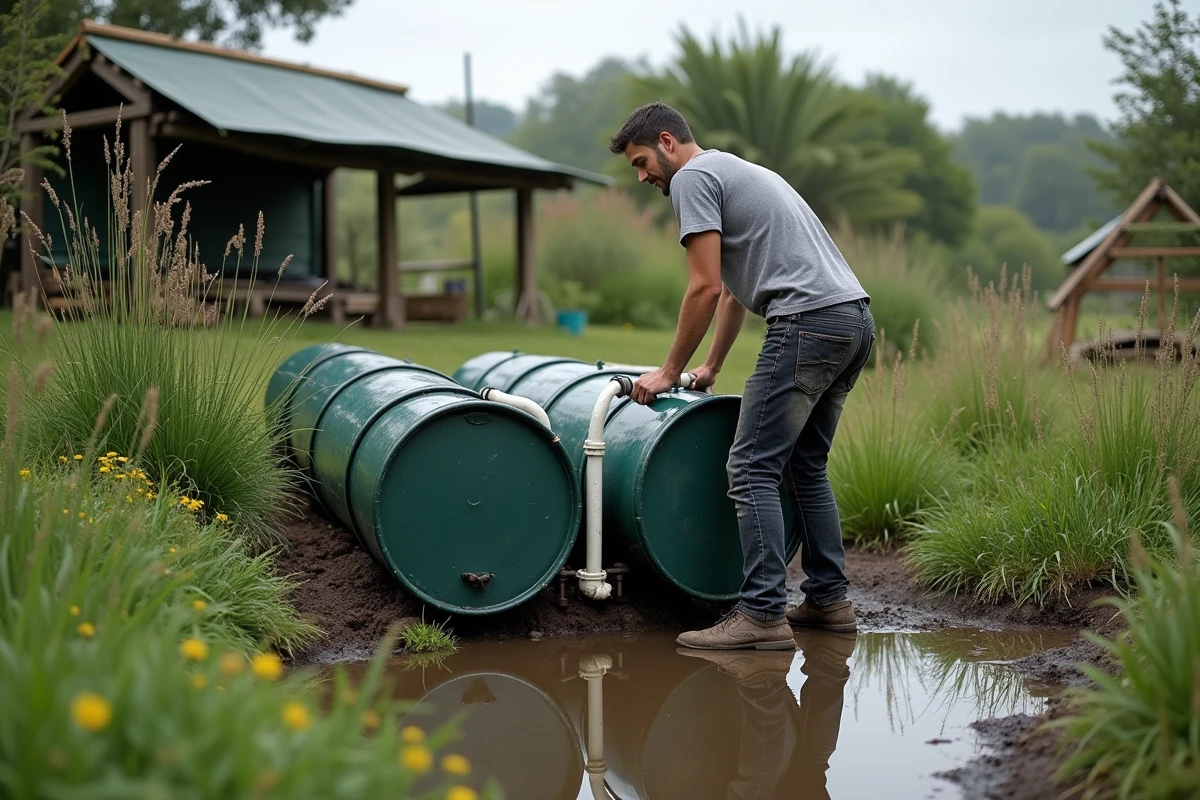
The most documented technique for collecting rainwater without a roof involves stretching a tarp or a shade cloth over a container. The principle is old, but recent experiments conducted in family gardens in Lyon and Nantes by the French Rainwater Association provide concrete insights into what works and what fails at the first gust of wind.
The 2023 experimental report from this association notes that lightweight structures like shade cloth or nets stretched over a tank offer a good compromise between catchment area and mechanical resistance. Triangular or rectangular sails, fixed on three or four sturdy stakes (wooden posts, sealed steel tubes), create a natural slope towards a low point where water flows into the tank.
Key points to monitor for this type of installation:
- The slope must be sufficient so that water does not stagnate in the center of the cloth, which creates a weight pocket capable of tearing the fixings.
- The material of the sail must be waterproof or have a very fine mesh. A standard shade cloth made of high-density polyethylene allows some water to pass between the fibers, which reduces the catchment efficiency.
- The fixings must include adjustable tensioners to compensate for the slackening of the fabric during rain and to retighten after each windy episode.
The secondary advantage of this setup, and it’s not trivial, is that it simultaneously reduces plant water stress through shading. INRAE and Ademe have reported since 2022 a trend to couple water harvesting with shading devices to reduce evaporation of stored water and watering needs during heatwaves.
Sizing Your Harvesting Tank for a Gutterless Garden
Installing a catchment surface is pointless if the container underneath overflows at the first serious downpour or empties after two waterings. The sizing of the tank depends on two variables: the actual catchment area and the frequency of use.
A sail of a few square meters captures much less than a house roof. It is necessary to think in terms of useful volume per rainfall episode rather than theoretical annual capacity. For a modest-sized vegetable garden, a tank of a few hundred liters is sufficient if it is regularly emptied through watering.
IBC-type tanks (reconditioned industrial containers) are the most commonly used in family gardens for their volume/price ratio. They have a drawback: their translucent wall promotes algae growth if they remain exposed to sunlight. An opaque cover or cladding with pallets solves the problem.
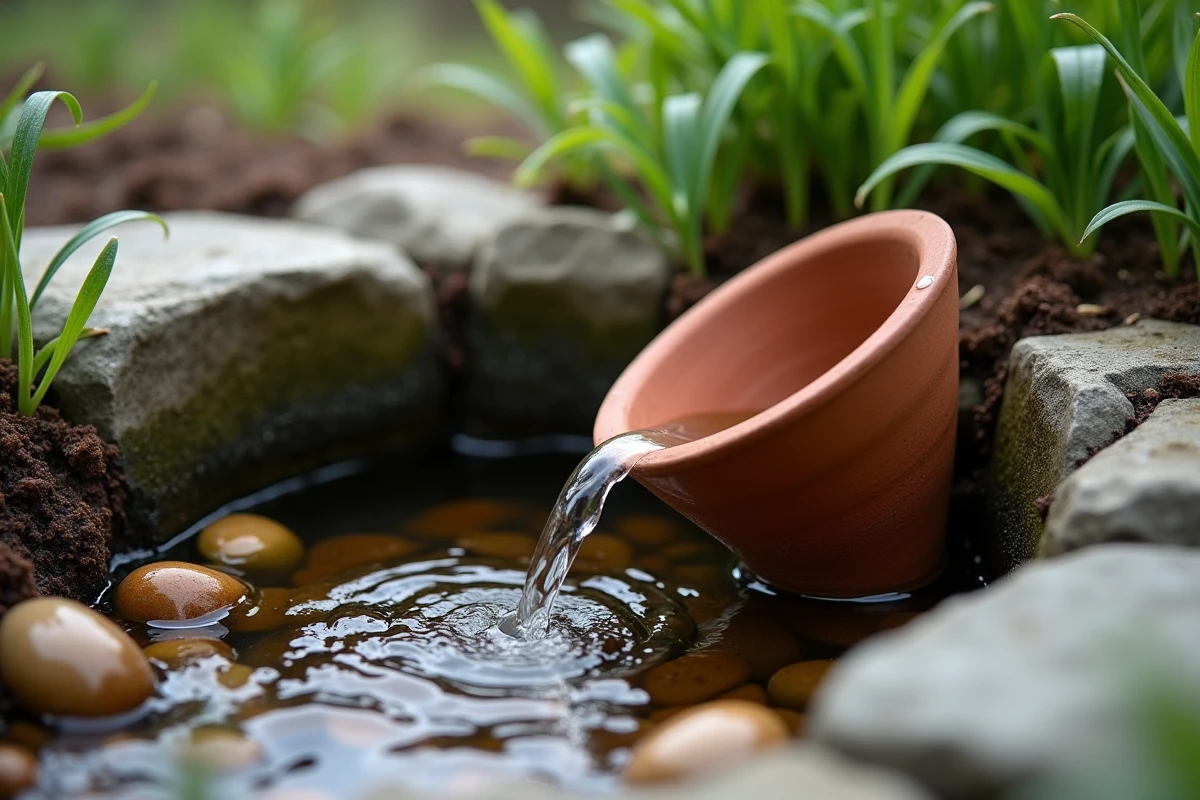
The choice between an above-ground tank and a buried tank mainly depends on the available space and the desire to draw water by gravity. An elevated tank on cinder blocks allows for watering with a hose without a pump, provided that the height difference between the tank’s tap and the watering point is at least a few dozen centimeters.
Maintenance and Filtration: Avoiding Sanitary Issues in the Garden
Rainwater collected outdoors, without passing through a roof, contains fewer mineral particles (no runoff on tiles or zinc) but accumulates plant debris, insects, and dust. A fine mesh filter placed between the catchment surface and the tank retains most of these elements.
The main health risk remains the proliferation of mosquitoes, particularly the tiger mosquito, which breeds in stagnant water. Every tank must be equipped with a tight-fitting lid or a mosquito net with sufficiently fine mesh. This point is not optional: an open tank in summer becomes a breeding site in just a few days.
Routine maintenance is limited to a few actions:
- Clean the inlet filter after each rainfall episode to avoid clogging.
- Empty the tank at least once per season to remove bottom deposits.
- Check the tightness of the connections and the lid before each prolonged rainy period.
A drainage overflow system directed towards a draining area of the garden (gravel bed, planted swale) prevents overflow and contributes to the local infiltration of rainwater, which several municipalities now encourage in their urban planning regulations.
Harvesting rainwater without a roof remains a compromise: the volumes captured are modest compared to a gutter installation, but they cover a significant part of the watering needs of a small garden. The sail-tank-filter setup, properly sized and maintained, functions over several seasons without heavy intervention.